 Family Reunion Articles
All articles · Games & Memory-Making
How to Run a Drop-In Lawn Game Afternoon for Every Skill Level
Set up yard game stations, mix skilled and new players, and keep a relaxed rotation going so the sidelines are as fun as the games.
by Ian · 5 min read
The short version
Yard games are the easiest way to get three generations laughing in the same spot. The trick is keeping it relaxed.
- Set up three or four game stations so nobody waits long.
- Pair a confident player with a newer one, and swap partners every round.
- Put shady chairs and cold water right next to the games, so watching is just as good as playing.
Short rounds, mixed teams and a good sideline. That's the whole plan.
This guide is for the relative with a decent patch of grass and a family that likes a little friendly competition. You'll get a station layout, a simple way to mix strong and new players, a timed plan for the afternoon, and ways to keep the sideline as much fun as the games.
The goal isn't to find the best player in the family. It's to get the cousins, the aunts and Grandpa on the same team at least once.
Best for
- Group size: 10 to 40 people, with people drifting in and out.
- Energy level: medium. Some people play hard, some sit and cheer.
- Prep effort: medium. Gathering or borrowing games is most of the work.
- Budget level: low, if relatives lend the games they already own.
- Ages it suits: about five and up for playing, with easy versions for little kids and for relatives who'd rather play seated.
Before the day
Start about four weeks ahead. Most of the early work is picking a date and a spot, then finding out who owns which games.
- 4 weeks out: pick the date and the yard or park. Ask who owns which games: bean bag toss boards, a ladder toss set, bocce balls, a giant block tower, a ring toss.
- 3 weeks out: decide on three or four stations. Ask the owners to bring their sets, and write down who brought what so everything goes home with the right family.
- 2 weeks out: plan shade. List who can bring a pop-up canopy, a patio umbrella or folding chairs.
- 1 week out: make the partner cards (see below) and a rotation board. A whiteboard or a big sheet of cardboard on an easel works.
- 2 days out: walk the yard. Look for holes, sprinkler heads and slopes. Mark them with a small flag or move a station away from them.
- The morning of: set up stations with plenty of room between them, put the shade and chairs along one side, and fill a cooler with water.
Run of show
- 1:00: stations set, cooler filled, sunscreen and bug spray on a table near the chairs.
- 1:30: people arrive. Let them warm up at any station for half an hour with no teams.
- 2:00: a two-minute welcome. Explain the stations, the round length and how partners are picked.
- 2:05 to 3:15: rounds one to five. Each round is about 12 minutes, then partners swap and everyone moves to the next station.
- 3:15 to 3:45: heat break. Everyone into the shade for water and snacks. Older relatives and little kids should rest, even if they say they're fine.
- 3:45 to 4:30: rounds six to eight, or open play for anyone who wants to keep going.
- 4:30: a family game to finish: everyone, all ages, on one giant block tower, taking turns until it falls.
- 4:45: pack up. Check your list so each set goes home with its owner.
Station setup and easier versions
Here's a simple layout for four stations, with a way to make each one fit any player.
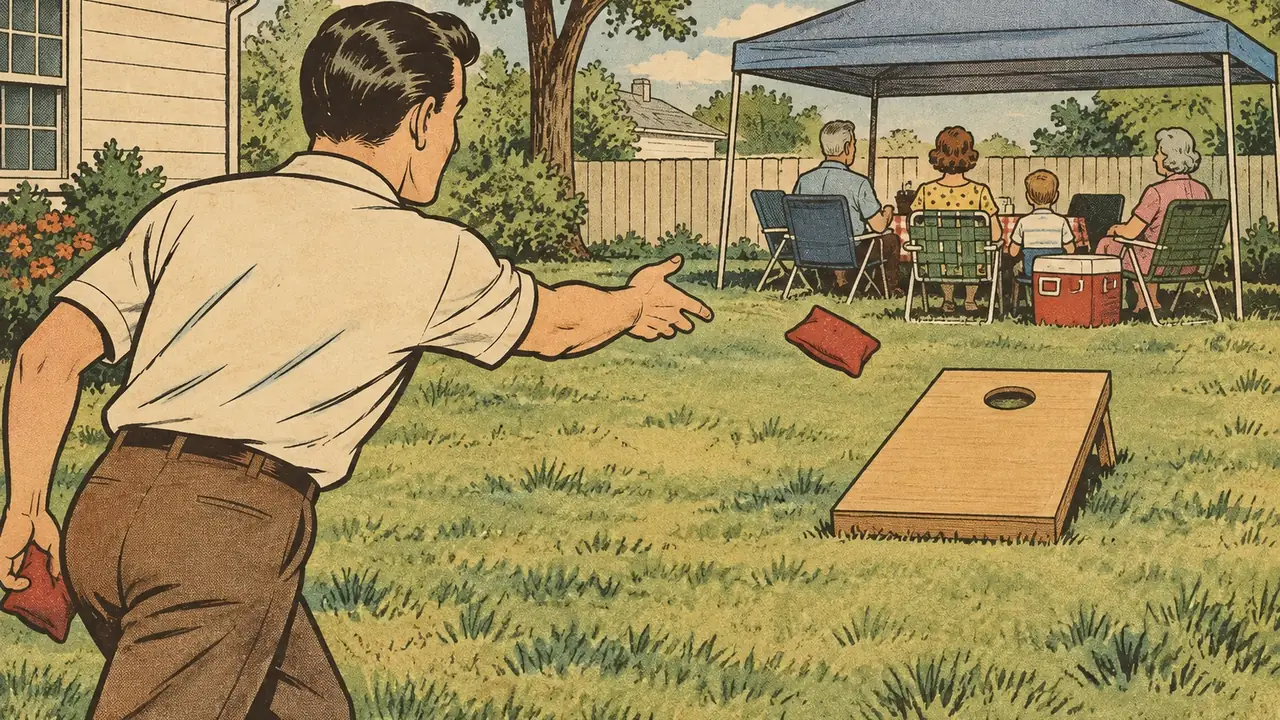
- Bean bag toss. Two slanted boards with a hole in each, set facing each other. Players stand beside one board and toss bags at the other. Space them far enough apart that a grown-up has to aim, and mark a second, closer line for kids and anyone who wants it, about halfway.
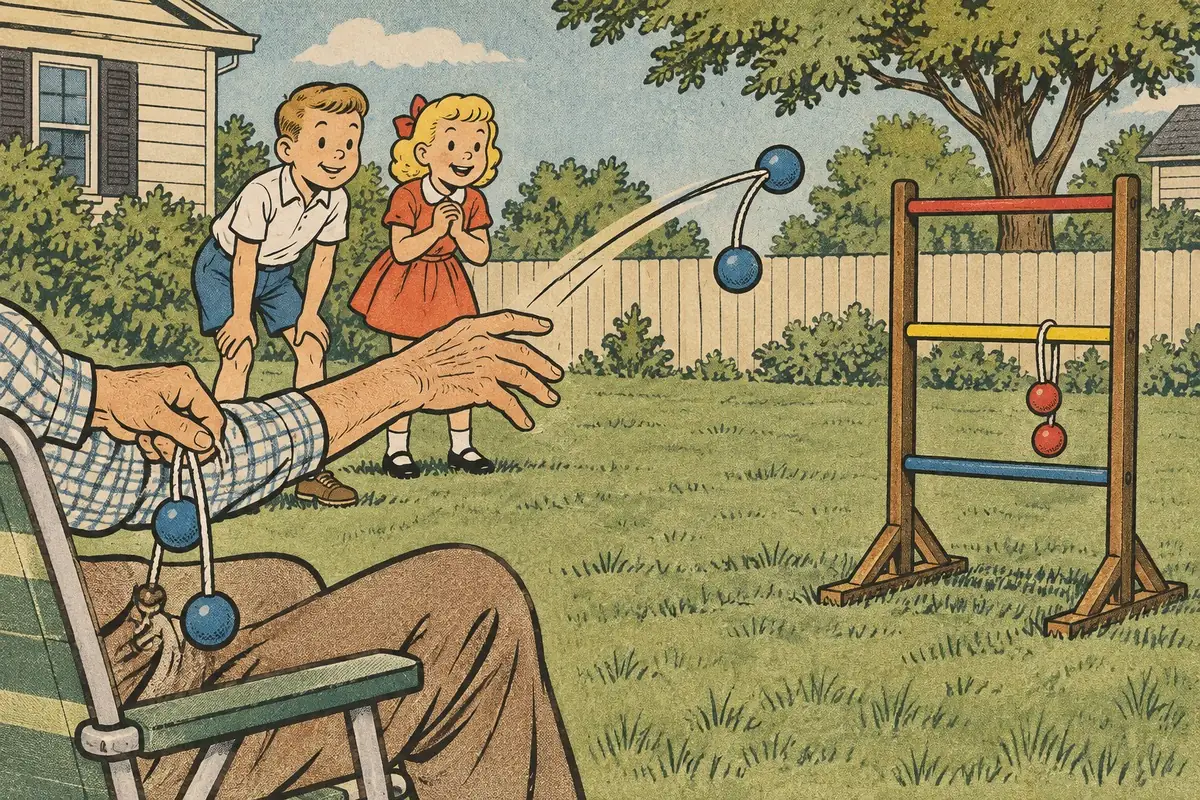
- Ladder toss. Players throw bolas, two balls joined by a short rope, so they wrap around the rungs of a small ladder. It works well from a chair, so it's a good station for relatives who'd rather sit.
- Bocce. Someone rolls the pallino, the small target ball, and each team rolls bigger balls to get closest to it. It's gentle, it's played at a walk, and it suits anyone who'd rather not run.
- Giant block tower. Players take turns pulling a block from the tower and stacking it on top, without knocking it down. It's good for little kids and doesn't need much room.
Leave at least a few big steps between stations, and point every throwing lane away from the chairs and the snack table. Little kids wander, so keep the toddler play area well behind the throwing lines.
The mixing rule: partner cards
The fastest way to make a yard game feel unfair is to let the best players team up. Here's how to stop that without making anyone feel ranked.
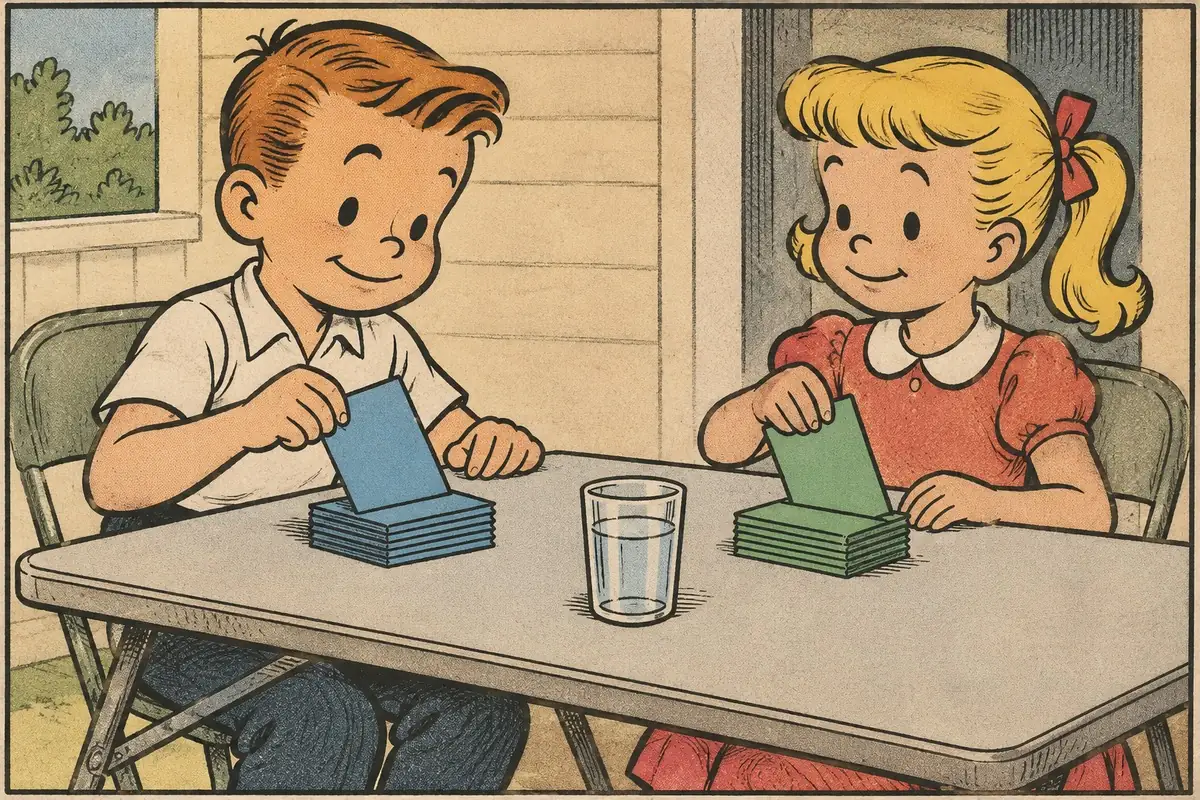
Make two sets of cards in two colors, say blue and green, numbered 1, 2, 3 and so on. Before each round, the people who play these games a lot draw blue, and everyone else draws green. Blue 3 and green 3 are partners. Let people pick their own color; most will be honest.
After each round, everyone draws again. In a few rounds, nearly everyone will have played with someone new. Write the pairs on the rotation board so people know where to go.
Keep score inside each game, just for fun, and then let it go. Nobody tracks a total across the afternoon. That keeps the mood light and stops the same few people from taking over.
Make the sideline the best seat
Half your family will spend the afternoon watching, and that's fine.
Put the chairs in the shade, close enough to see the games, but out of the throwing lanes. Mix in chairs with arms for older relatives. Keep water, sunscreen and snacks right there, with a few labeled gluten-free, nut-free or vegetarian. Write the round length on the board for anyone who didn't hear the welcome.
Give teens a job if they want one. One can run the rotation board, one can keep a phone handy for photos, and one can be the "bag fetcher" for a relative who plays seated.
If a relative can't travel, a cousin can call them on a video call app during the last round so they can watch the block tower fall.
Common pitfalls
- Long lines at one game. Fix: at least three stations, short rounds, and a swap every 12 minutes.
- The same strong players always win. Fix: partner cards, a new draw every round, and no running total.
- People overheat. Fix: shade by the stations, water within reach, sunscreen on the table, and a set heat break where everyone sits.
- Someone gets hit by a bag or a ball. Fix: throwing lanes pointed away from chairs, and little kids kept behind the lines.
- Relatives who can't stand for long feel left out. Fix: ladder toss and bocce from a chair, and a closer throwing line for anyone.
- Games go home with the wrong family. Fix: a list of who brought what, checked at pack-up.