 Family Reunion Articles
All articles · Games & Memory-Making
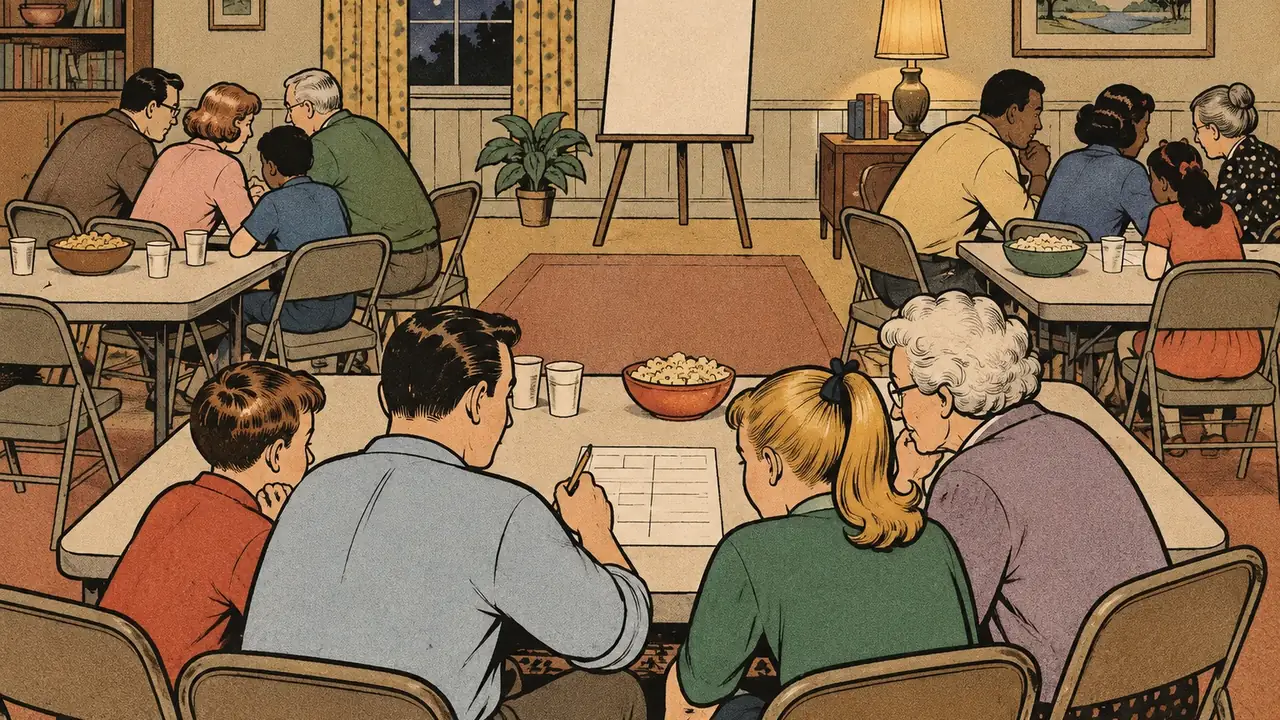
Family Trivia Night Every Generation Can Play
Run a family trivia night where kids, parents and grandparents all score: 12 sample questions, a team-balancing rule and a timed plan.
by Ian · 6 min read
The short version
Who was the first in your family to leave home? Bet the teens don't know. Bet Grandma does.
- Mix every team: at least one kid, one teen, one parent and one grandparent at each table.
- Give each generation a round where they're the experts, including one the teens write.
- After each family question, let the person it's about tell the story in thirty seconds.
This guide is for the relative who wants an evening game that the whole family plays together, not one where the same three uncles answer everything. You'll get a timed plan, rules for writing questions every age can answer, 12 sample questions, and a team-balancing rule that keeps any one generation from running the show.
Best for
- Group size: 12 to 40 people, in teams of four to six.
- Energy level: medium and noisy, in a good way.
- Prep effort: medium. Writing and checking the questions takes a few evenings.
- Budget level: low: paper, pens, snacks.
- Ages: about 8 and up. Younger kids can join a parent's team and help with the kids' round.
Before the day
- 4 weeks out: Pick a quizmaster, someone who'll read the questions and not play. Ask two or three relatives from different generations to help write.
- 3 weeks out: Collect family facts. Ask the older relatives about firsts, moves, pets and hometown spots. Ask the teens to write their own round.
- 2 weeks out: Write the questions, about 24 in four rounds. Check every family answer with two people. Memories differ, and you want to settle that before the night, not during it.
- 1 week out: Make the answer sheets, one per team per round. Write each question in big letters on poster paper or a whiteboard, too.
- The day before: Sort names into the four groups for the team draw (below). Make a label for each snack: vegetarian, gluten-free, or what it contains.
Run of show
This plan runs from 7:00 to 8:45 p.m.
- 6:45 p.m. Tables set, one sheet and pen per team, snacks out.
- 7:00 p.m. Welcome and the team draw, 10 minutes. Teams pick a name.
- 7:10 p.m. Round 1, Family firsts. Six questions, about 12 minutes with stories.
- 7:25 p.m. Round 2, The old days. The grandparents' round.
- 7:40 p.m. Break, 15 minutes. Refill snacks, stretch, tally the scores.
- 7:55 p.m. Round 3, Then and now.
- 8:10 p.m. Round 4, The kids and teens round.
- 8:25 p.m. Final scores, then each team shares the best story they heard tonight.
- 8:45 p.m. Wrap up.
How to write questions every generation can answer
The hard part of family trivia is that each generation knows a different world. A question about rotary phones stumps the kids, and a question about a phone app stumps Grandpa. That's fine, as long as every round gives someone else their turn.
- One question, one clear answer. Check family answers ahead with two people.
- Mix easy, medium and hard in every round, so no team goes a whole round without a point.
- Give each generation a round where they're the experts.
- Use multiple choice for the hard family questions. Three names to pick from gives everyone a fair shot.
- Keep it kind. Skip anything about money, divorces, health or a recent loss, unless the family wants it there.
- Add a story bonus. After a family answer is read out, the person it's about gets 30 seconds to tell what happened. It's worth no points and it's the best part of the night.
12 sample questions
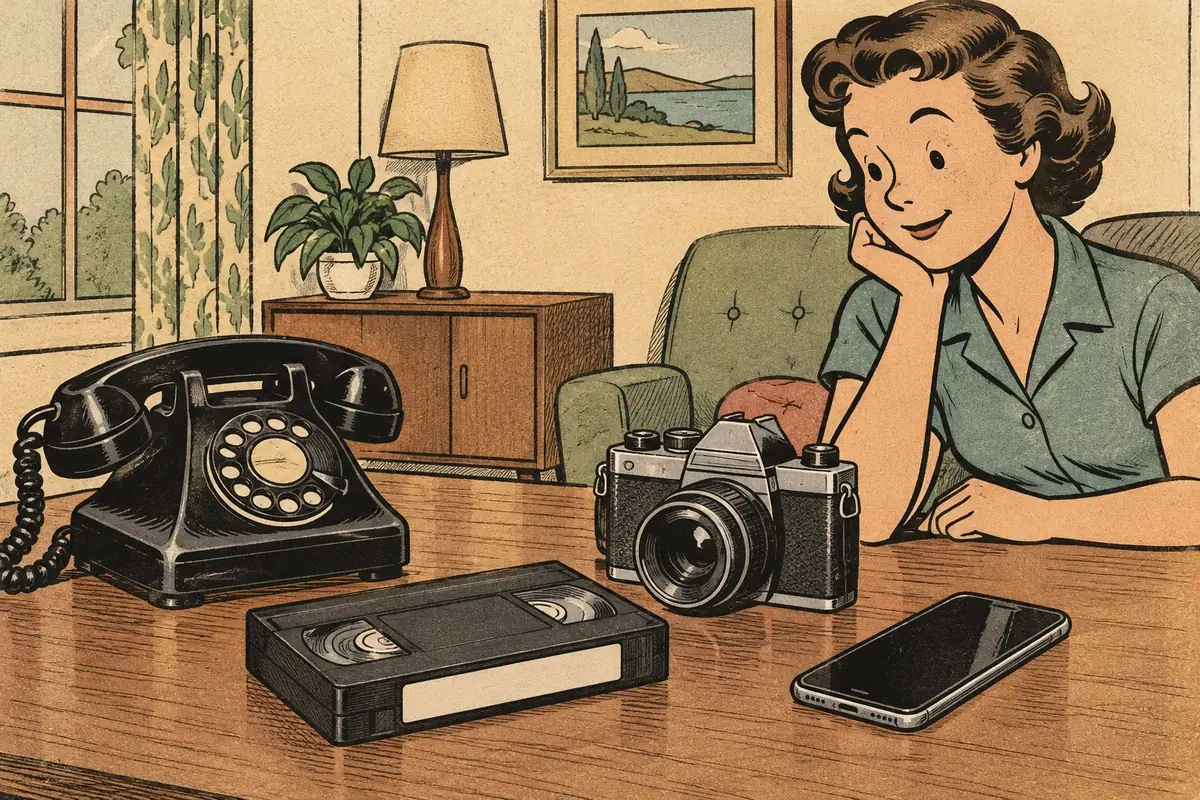
Swap in your own family's answers for the first four.
Round 1: Family firsts
- Who was the first person in the family to move to another state or country? (Give three names to choose from.)
- In what town did Grandma and Grandpa first meet?
- What was the name of the first family pet that anyone here remembers?
Round 2: The old days (the grandparents' round)
- Where did the family always go for a treat after ballgames?
- Before streaming, what were you supposed to do to a rented movie tape before you took it back? (Rewind it.)
- On a rotary phone, how did you dial a number? (Put a finger in the hole for each digit, turn the dial to the stop, and let it spin back.)
Round 3: Then and now
- Before phones had cameras, what had to happen before you could see your vacation pictures? (The film had to be developed and printed.)
- With dial-up internet, what couldn't anyone else in the house do while you were online? (Use the home phone, unless you had a second line.)
- Before phones had maps, how did people find their way on a road trip? (A paper map, or stopping to ask for directions.)
Round 4: The kids and teens round
- What does it mean to "screenshot" something? (Save a picture of what's on your screen.)
- The teens pick a word or phrase they use right now. Each team writes what they think it means, and the teens judge.
- What's the most-played game at the kids' table this year? (The kids decide the answer ahead of time.)
The team-balancing rule
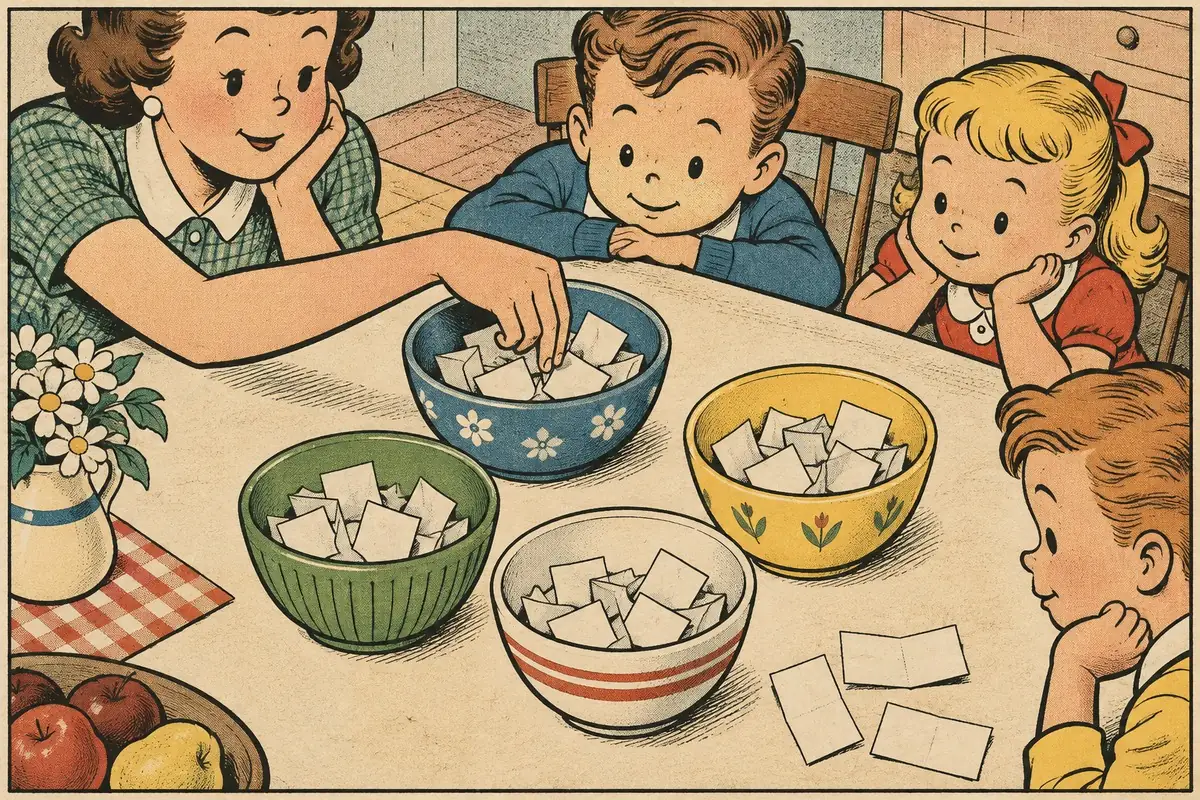
Here's the rule: every team gets one person from each generation before anyone gets a second.
- Write each name on a slip and sort the slips into four bowls: kids (about 8 to 12), teens, adults, and grandparents and great-aunts and uncles.
- Each team draws one slip from every bowl in turn.
- When a bowl runs out, the leftovers from the other bowls spread across the teams, one at a time.
- Split up couples and siblings where you can. It's more fun, and it stops one household from carrying a table.
Then add the pen rule: the answer sheet and pen move one seat to the left after every question, and whoever holds the pen writes the team's final answer. That way the youngest player gets the last word some of the time, and the loudest player doesn't get it every time.
Common pitfalls
- One generation answers everything. Fix: the four-bowl draw, the pen rule and a round for each age.
- A family answer turns into an argument. Fix: check family facts with two people ahead, and let the quizmaster's answer key settle it.
- People can't hear the questions. Fix: the quizmaster faces the room, reads each question twice and points to the poster where it's written.
- Tables are hard to reach. Fix: leave a clear path for walkers and wheelchairs, and give anyone who needs it a seat near the door.
- The night runs long. Fix: six questions a round and a timer for the stories.
- A relative who can't travel is left out. Fix: they write and read Round 2 live from home on your family's video call app.